
Best Mortgage Lenders in Arizona 2026 Ranked and Reviewed
Finding the best mortgage lenders in Arizona in 2026 takes more than typing a search and calling the first name that comes up. Arizona is one of the fastest-growing states in the country, Phoenix regularly ranks among the top relocation destinations in America, and the housing market here moves at a pace that punishes buyers who are not prepared. The median home sale price in Arizona was $453,100 as of March 2026, and the number of homes sold was up 9% year over year, which tells you demand has not slowed down even as mortgage rates have stayed elevated.
The lender you choose changes more than your rate. It changes how fast you close, whether you qualify for state down payment help, and whether a loan officer who actually knows Arizona programs is in your corner. I pulled data from official HMDA filings, reviewed the state’s assistance programs directly from the Arizona Industrial Development Authority, and compared what each lender actually delivers for buyers in Phoenix, Tucson, Scottsdale, Flagstaff, and across rural Arizona. Here is what you need to know before you apply.
What Arizona Buyers Need to Know About the Market in 2026
Arizona is not one housing market. It is a collection of markets that barely resemble each other. Scottsdale luxury properties sit at a median around $1 million. Phoenix proper sits closer to $455,000. Tucson comes in around $311,000. Maricopa, about 35 miles south of Phoenix, averages closer to $335,000. Arizona welcomed nearly 85,000 new residents in 2023 to 2024 alone, and that steady population inflow is one of the key reasons housing demand has remained strong even as affordability is squeezed.
Arizona’s economy continues to benefit from growth in advanced manufacturing, healthcare, technology, and logistics. Semiconductor manufacturing is a major contributor, with large-scale chip production facilities in the Phoenix metro supporting thousands of high-paying jobs and related supply chain growth. That job market is what keeps the buying pressure on in the Phoenix Valley.
Mortgage rates in Arizona are expected to hover around 6.1% in 2026, slightly down from the 6.4% range seen in the second half of 2025. That is not the 3% era buyers remember, but with the right lender and the right program, the monthly payment difference between a good and a bad loan choice can be $200 to $400 per month on a $400,000 home.
2026 Loan Limits You Need to Know Before You Shop
Before you talk to a single lender, know the numbers. The conforming loan limit for a single-family home in Arizona is $832,750 for 2026, and this applies uniformly across all Arizona counties, including Phoenix, Tucson, Scottsdale, and Flagstaff, since no Arizona county qualifies as a high-cost area under FHFA guidelines.
Borrow more than $832,750 and you are in jumbo loan territory. Jumbo loans require stronger credit, typically 700 or above, larger down payments, and come with higher rates and more documentation requirements. Most Arizona buyers are not in jumbo territory, but if you are eyeing Scottsdale or Paradise Valley, keep this limit in mind.
FHA loan limits in Arizona vary by city. In Phoenix, Mesa, Chandler, Scottsdale, Glendale, Gilbert, Tempe, Peoria, and Surprise, the FHA limit for a single-family home is $557,750. In Tucson, Yuma, Prescott, Kingman, and Payson, the limit is $541,287. FHA loans require as little as 3.5% down with a 580 credit score, making them one of the most used loan types for first-time Arizona buyers.
Use our free loan eligibility checker to see what loan type fits your income, credit score, and target price before you sit across from any lender.
Rates and requirements change frequently. Always verify directly with lenders before making decisions.
Best Mortgage Lenders in Arizona 2026 Ranked by Buyer Type

No two buyers have the same situation. A first-time buyer in Tucson with a 620 credit score needs a completely different lender than a veteran in Chandler or a self-employed contractor in Flagstaff. Here is how the top Arizona lenders actually compare when it matters.
Rocket Mortgage: Best for Speed and Digital Borrowers
Rocket Mortgage originated $1.7 billion in Arizona home purchase loans, ranking second in the state behind UWM, and dominated Arizona refinancing as well. Volume like that does not happen by accident. Rocket’s fully digital process and dedicated loan officers mean most borrowers can get a preapproval in minutes and close in well under 30 days. The Truth About Mortgage
Rocket accepts credit scores as low as 580 for FHA loans and 620 for conventional loans, and offers VA, jumbo, and fixed-rate terms from 10 to 30 years. Nationally, Rocket originated 429,332 loans in 2025, leading all lenders by loan count. That scale means their systems are tested, their process is tight, and delays from paperwork errors are rare.
The honest downside is that Rocket is not always the cheapest. Its convenience comes with rates that can run slightly higher than a local credit union or broker who is willing to shop wholesale channels. And if you need someone to walk you through Arizona’s HOME Plus program or connect you to city-level down payment assistance, Rocket’s call-center model is less personal than a local loan officer who knows these programs by heart.
Who Rocket works for: W-2 borrowers with 620-plus credit scores who want a fast, clean digital process. Who it does NOT work for: Self-employed buyers with complex income, or buyers who need heavy guidance on state and local assistance programs.
Fairway Independent Mortgage: Best for Local Arizona Service
Fairway Independent ranked third in Arizona home purchase loan volume with $1.4 billion funded, and what separates them from the big national platforms is their ground-level presence. Fairway has loan officers based in Phoenix, Tucson, Scottsdale, Mesa, and smaller markets like Yuma and Prescott who know Arizona’s county programs, local appraisers, and which assistance programs actually have funding available right now. The Truth About Mortgage
Fairway participates in the Arizona HOME Plus program, offers FHA, VA, USDA, and conventional loans, and is consistently rated well by Arizona buyers who value a real person walking them through the process. The trade-off: Fairway’s rates can vary branch to branch. I have seen buyers get two Fairway quotes from officers 20 miles apart that differed by 0.25%. Always get at least two quotes if Fairway is your starting point.
Who Fairway works for: Buyers who want local expertise, program knowledge, and a real loan officer relationship rather than a call center. Who it does NOT work for: Borrowers who want rock-bottom rates through aggressive wholesale pricing.
CrossCountry Mortgage: Best for Non-Traditional Borrowers
CrossCountry Mortgage ranked fourth in Arizona home purchase volume with $1.3 billion funded. CrossCountry’s edge is breadth. They offer bank statement loans for self-employed borrowers, DSCR (debt service coverage ratio) loans for investors, asset depletion loans for retirees, and standard FHA, VA, and conventional products under one roof.
If you are self-employed in Arizona and your tax returns show heavy write-offs, CrossCountry is one of the few retail lenders that will seriously evaluate your actual bank deposits over 12 or 24 months rather than dismissing you outright. For a contractor in Tempe earning $150,000 per year but reporting $70,000 after deductions, this distinction can be the difference between approval and rejection.
Nationally, CrossCountry ranked third in 2025 loan count with 125,099 loans, behind only Rocket and UWM. They are growing fast and have the systems to match. HousingWire
Who CrossCountry works for: Self-employed buyers, real estate investors, retirees using assets rather than income, and borrowers with non-traditional financial profiles. Who it does NOT work for: Buyers who want a strictly simple, streamlined process with no complexity.
Veterans United: Best for Arizona Veterans and Military Families
Veterans United is the nation’s largest VA loan lender by volume, and Arizona has a large active-duty and veteran population, particularly around Luke Air Force Base in Glendale and Davis-Monthan Air Force Base in Tucson. Veterans United provides free credit counseling for veterans who need to improve their scores before applying, which is a meaningful benefit if you are transitioning out of service with a thin credit file.
VA loans require no down payment and no private mortgage insurance (PMI). PMI is the monthly fee conventional borrowers pay when they put less than 20% down, and it typically runs $100 to $200 per month on an Arizona home in the $400,000 to $500,000 range. Over a 5-year period, avoiding PMI saves you $6,000 to $12,000 on top of the zero down payment benefit.
The VA does charge a one-time funding fee. That fee runs from 1.4% to 3.6% of the loan amount depending on your down payment and whether it is your first VA loan. On a $400,000 purchase with no down payment, a first-time VA borrower pays a funding fee of roughly $8,600, which can be rolled into the loan.
Who Veterans United works for: Active duty, veterans, and eligible surviving spouses buying or refinancing any home in Arizona. Who it does NOT work for: Non-military buyers, or veterans who also need FHA or conventional loan comparisons from the same lender.
Guild Mortgage: Best for Flexible Credit in Arizona
Guild Mortgage ranked in the Arizona top 10 for home purchase volume, and their reputation comes from one thing: accepting borrowers that other lenders turn away. Guild accepts borrowers with a 600 credit score for its Zero Down mortgage when income requirements are met, and also considers non-traditional credit sources like rent and utility payments for borrowers with thin files.
Guild is a strong choice for Arizona buyers rebuilding credit after a past financial hardship, buyers with limited credit history, or anyone whose profile does not fit cleanly into the automated underwriting boxes that Rocket or Chase would run them through.
Who Guild works for: Buyers with 580 to 650 credit scores, thin credit files, or those who need manual underwriting to get a fair review. Who it does NOT work for: Prime borrowers with 740-plus scores who could get a sharper rate elsewhere.
Nova Home Loans: Best Arizona-Based Local Lender
Nova Home Loans, headquartered in Tucson, ranked in the Arizona home purchase top 10 and stands apart as a genuinely local institution with deep roots in the state’s market. Nova participates in Arizona’s HOME Plus program and local city assistance programs, and their loan officers are embedded in the same communities where Arizona buyers are shopping. If you are buying in Tucson, Nogales, or southern Arizona, a conversation with Nova is worth the call.
Use our free mortgage calculator to estimate your exact monthly payment on any loan amount, interest rate, and term before you commit to anything, no signup required.
Arizona HOME Plus and State Down Payment Programs
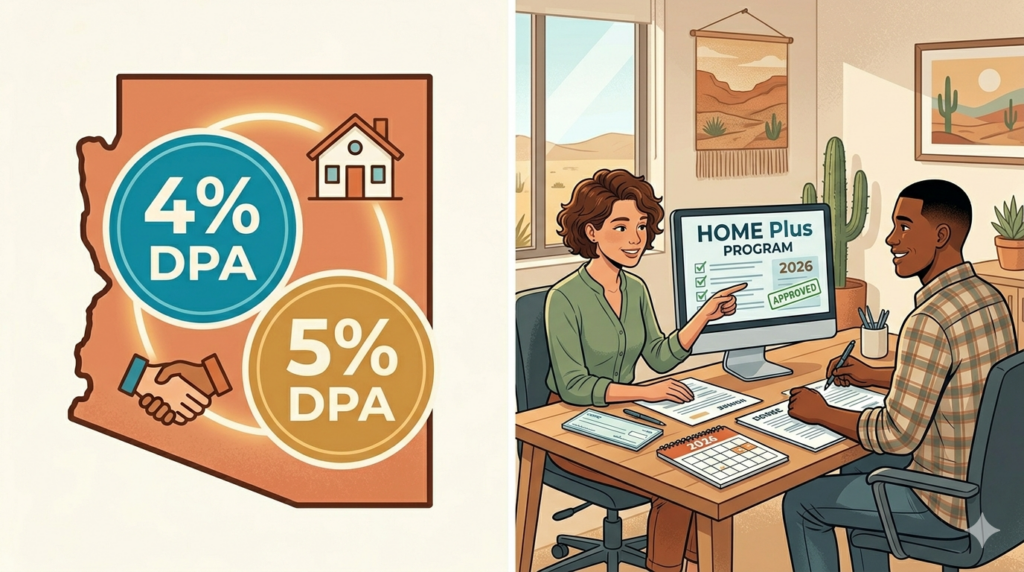
Most national lenders will mention HOME Plus in passing. Very few explain how it actually works and who it actually helps. Here is what every Arizona buyer should know.
The HOME Plus program is the only state-run, statewide homebuyer down payment assistance program in Arizona and is available in every county, city, and zip code across the state. Over 32,000 Arizona buyers have used it. That is not a niche program. That is a mainstream tool that too many buyers leave on the table because their lender did not bring it up. Arizona Department of Housing
As of April 2026, the income limit for HOME Plus is $155,386 per year based on borrower gross income, not household income. One borrower must complete a homebuyer education course before closing. The program also comes with reduced mortgage insurance premiums on conventional loans through Fannie Mae and Freddie Mac.
HOME Plus offers up to 5% of the home purchase price as down payment and closing cost assistance, structured as a second mortgage that is fully forgiven after 60 months. HOME Plus funding is consistently available throughout the year and carries no sunset date. That last point matters. Some Arizona programs run out of funds mid-year and pause. HOME Plus does not.
The maximum DTI (debt-to-income ratio) allowed under HOME Plus is 45% if your credit score is 640, and 50% if your score is 680 or above. DTI compares your total monthly debt payments, including the new mortgage, to your gross monthly income. If you earn $7,000 per month, your total monthly debts including mortgage, car payment, and credit cards should not exceed $3,150 at the 45% limit. Arizonadownpaymentassistance
You can find current rates and participating lenders directly on the Arizona Department of Housing website before approaching any lender.
Arizona Is Home Program: For Rural County Buyers
The Arizona Is Home program is available in Apache, Cochise, Coconino, Gila, Graham, Greenlee, La Paz, Mohave, Navajo, Pinal, Santa Cruz, Yavapai, and Yuma counties, but is not available in Maricopa County, Pima County, or Chino Valley. If you are buying outside the Phoenix or Tucson metro areas, this program may be available to you.
Arizona Is Home provides a below-market 30-year fixed-rate mortgage combined with 4% down payment assistance. Eligible borrowers must have annual incomes at or below 100% of the Area Median Income for their county. The program is for first-time homebuyers. Annual funding for 2026 is limited to $55 million and will pause once those funds are exhausted. If you qualify, apply early in the year before funding runs out.
City-Level Programs Worth Knowing
Phoenix, Maricopa County’s most competitive market, has its own program worth knowing about. The Home in Five Advantage program, offered through a partnership between Maricopa County and the city of Phoenix, provides up to 6% of the home purchase price in down payment and closing cost assistance. Eligibility requires a minimum 640 credit score, household income below $153,440, DTI below 50%, and the buyer must move in within 60 days of closing.
The City of Tucson’s DPA Program, administered through Pima County, provides loan amounts of up to 20% of the contract sale price. To qualify, buyers must contribute at least $1,000 of their own funds, complete HUD-certified counseling, secure a fixed-rate mortgage, and have two months of mortgage payments in reserves.
If you are pairing any of these city or state programs with FHA financing, our FHA loans guide walks through exactly which lenders are most likely to approve your application when DPA is involved.
Mistakes Arizona Buyers Make When Choosing a Lender

I have seen buyers lose money at every stage of this process. The mistakes are usually the same ones, and almost all of them are avoidable.
Getting One Quote and Stopping There
This is the most expensive mistake an Arizona buyer makes. Rates on the same loan type can vary by 0.25% to 0.50% between lenders on the same day for the same borrower. On a $430,000 loan in Phoenix with a 30-year term, the difference between a 6.5% and a 6.875% rate is roughly $97 per month and over $34,000 across the life of the loan. The CFPB recommends getting at least three to five loan quotes before committing. That comparison takes one afternoon and can save more than most buyers spend on a new car.
Not Checking Your DTI Before You Walk In
HOME Plus and most government-backed Arizona programs require a back-end DTI at or below 45% for borrowers with a 640 credit score. Many buyers do not calculate this before sitting with a lender and then discover that a car payment or student loan they forgot about pushes them over the line. Check this number first. Use our free DTI calculator to see exactly where you stand and whether paying off one small debt would open up better loan options or program eligibility. Arizonadownpaymentassistance
Assuming Your Bank Will Give You the Best Deal
Branch loyalty is costing Arizona buyers money. Big banks like Chase and Bank of America offer convenience, but their mortgage rates are not always competitive with independent lenders. Banks also have stricter overlays, meaning they layer additional requirements on top of FHA and VA minimums. A buyer with a 610 credit score who would qualify for an FHA loan through Fairway or Guild might get declined at a big bank that has set its internal floor at 640.
Underestimating Closing Costs in a Hot Market
Arizona buyers typically pay closing costs of 2% to 5% of the purchase price. On a $430,000 home in Phoenix, that is $8,600 to $21,500 in addition to the down payment. Some lenders offer no-closing-cost mortgages, but those costs get rolled into your interest rate, meaning you pay more every single month for the life of the loan. Whether rolling costs into the rate makes sense depends entirely on how long you plan to stay in the home. Our free refinance calculator can help you model the break-even point on any rate-versus-cost trade-off.
Who Should NOT Use Arizona State Assistance Programs
State programs are not right for everyone, and being honest about this saves time.
If your household income is above $155,386 per year, you do not qualify for HOME Plus based on current 2026 limits. If you are buying in Phoenix or Tucson and targeting the Arizona Is Home program, you will not be eligible since that program excludes Maricopa and Pima counties. And if you need to close in under 21 days on a competitive offer, any program that requires a compliance review and education course adds time to your closing timeline.
High-credit borrowers with 740-plus scores putting 20% down often benefit more from a clean conventional loan than from a state program with additional overlays. The interest rate savings from a strong credit profile can outpace the value of DPA assistance over a 30-year term, especially in cases where the assistance comes as a second lien that must be repaid if you sell or refinance within 60 months.
How to Choose the Right Lender for Your Arizona Situation
Start with your profile, not with whoever sent you a mailer.
First-time buyer in Phoenix or the East Valley with limited savings and a 620 to 660 credit score: Look at HOME Plus-participating lenders and ask specifically about the Home in Five Advantage program if you are in Maricopa County. Compare at least two participating lenders before choosing one.
Veteran buying near Luke or Davis-Monthan: Start with Veterans United for VA loan expertise, but also get a quote from Fairway or Nova who have local experience pairing VA loans with Arizona state programs.
Self-employed buyer in Scottsdale or Chandler: CrossCountry Mortgage and Guild are your best starting points. Bring 12 to 24 months of bank statements to your first conversation, not just your tax returns.
Refinancer who locked a rate above 7% in 2023: Rocket Mortgage dominated Arizona refinancing volume and their streamline refinance process for FHA and VA borrowers is fast and low-documentation. Get their quote, then compare with your current servicer’s retention offer. The Truth About Mortgage
Before meeting with any lender, use our mortgage rate comparison tool to see current Arizona rate ranges so you walk in knowing what a fair offer actually looks like.