Best Mortgage Lenders in Texas 2026 Ranked and Reviewed
Picking the best mortgage lenders in Texas in 2026 is not as simple as searching online and calling whoever ranks first. Texas is the second-largest state in the country, and its housing market behaves differently depending on which city you are in. Dallas is stabilizing after price corrections. Houston is holding modest gains. Austin is working through a correction from its pandemic-era peak. San Antonio is seeing prices cool. Nearly 391,243 people moved to Texas last year alone, according to the US Census Bureau, and that steady population growth keeps housing demand high even as prices moderate.
I pulled HMDA data on the actual volume leaders in Texas, reviewed state assistance programs directly from TDHCA and TSAHC, verified the 2026 loan limits, and compared what each lender genuinely delivers for different buyer profiles across the state. Whether you are a first-time buyer in Houston, a veteran in San Antonio, a self-employed contractor in Austin, or a repeat buyer looking to upsize in DFW, here is what you need to know before you sign anything.
What Texas Buyers Need to Know About the 2026 Housing Market
Texas is not a single market. It never has been. Statewide, the December 2025 median home price held at $330,000, but individual metros told very different stories: Austin prices declined 2.9% year over year, San Antonio fell 1.9%, Dallas saw nine straight months of modest year-over-year declines, and Houston softened by 0.6%.
That is actually good news for buyers who have been sitting on the sidelines. Sellers in many Texas markets are negotiating hard right now, offering concessions that were unthinkable during 2021 and 2022. The Dallas Fed projects roughly 155,000 new jobs created in Texas in 2026, and Houston projects 30,900 new jobs this year alone, which means the economic foundation under Texas housing remains solid even as prices cool at the surface.
For buyers, a stable market with motivated sellers and a good lender in your corner is a better environment than the frenzied bidding-war years. The lender you choose still matters enormously, because rate differences compound over 30 years.
2026 Loan Limits Across Texas
Before sitting down with any lender, know your numbers. The conforming loan limit for a single-family home in Texas is $832,750 for 2026, and this applies uniformly across all Texas counties, including Dallas, Houston, Austin, and San Antonio, since no Texas county qualifies as a high-cost area under FHFA guidelines.
Borrowing above $832,750 pushes you into jumbo loan territory, which means stricter qualification standards, typically a 700-plus credit score, a larger down payment, and rates that run 0.25% to 0.50% higher than conforming loans.
FHA loan limits in Texas for 2026 range from $541,287 in lower-cost counties up to $813,050 in the highest-cost metro areas. FHA loans require as little as 3.5% down with a 580 credit score, making them one of the most used loan types for first-time Texas buyers, especially in markets like Houston and San Antonio where home prices sit closer to $300,000 to $375,000. LendingTree
Use our free loan eligibility checker to see what loan type fits your income, credit score, and target purchase price before you talk to a single lender.
Rates and requirements change frequently. Always verify directly with lenders before making decisions.
Best Mortgage Lenders in Texas 2026 Ranked by Buyer Type
No two Texas buyers have the same situation. What works for a first-time buyer in San Antonio with a 640 credit score is completely different from what a self-employed buyer in Austin or a veteran in Killeen needs. Here is how the top Texas lenders actually compare when it counts.
Rocket Mortgage: Best for Speed and Refinancers
Rocket Mortgage ranked second in Texas overall home loan volume with $7.0 billion funded, and dominated Texas refinancing volume as the clear number one in the refi market. That is not an accident. Rocket’s digital-first process and round-the-clock support mean most straightforward borrowers can get a preapproval in under an hour and close in 22 days or less on average, roughly half the industry standard.
Rocket accepts credit scores as low as 580 for FHA loans and 620 for conventional loans, and offers VA, USDA, jumbo, and fixed-rate terms from 10 to 30 years. For Texas borrowers who bought at 7% or above in 2023 and are now watching rates ease, Rocket’s FHA Streamline and VA IRRRL (Interest Rate Reduction Refinance Loan) options are fast, low-paperwork paths to a lower monthly payment.
The honest downside is that Rocket is a call-center model. If you need a local Texas loan officer who personally knows the TDHCA program guidelines, has relationships with local appraisers, or can navigate a complex self-employed file, Rocket is not the right fit. Their strength is clean, straightforward W-2 borrowers who want a fast digital experience.
Who Rocket works for: Salaried borrowers with 620-plus credit scores, digital-first buyers, and current homeowners looking to refinance. Who it does NOT work for: Self-employed buyers with complex income, buyers needing hands-on guidance through state assistance programs, or anyone with a complicated file that needs manual underwriting.
DHI Mortgage: Best for New Construction Buyers in Texas
DHI Mortgage, the in-house lending arm of DR Horton, ranked third in overall Texas loan volume and second in Texas home purchase loans. If you are buying a new construction home in Texas, particularly in the fast-growing suburbs around Dallas, Houston, San Antonio, or Austin, DHI is a name you will encounter frequently. DR Horton is the largest homebuilder in the country, and in Texas they are building aggressively across the DFW Metroplex, Houston’s outer suburbs like Katy and Pearland, and San Antonio’s growing northwest corridor.
The reason DHI consistently captures so much volume is simple: they offer mortgage rate buydowns that outside lenders physically cannot match. When a builder offers a 2-1 buydown that lowers your rate by 2% in year one and 1% in year two, the effective payment savings in the first two years can run $400 to $700 per month on a $350,000 loan. No independent lender can replicate that.
The honest trade-off is that DHI is tied to DR Horton homes. You cannot use DHI to buy a resale property, and some buyers report feeling pressured to use the builder’s lender to keep their closing incentives. Always get an outside quote from at least one independent lender before signing with any builder’s financing arm, because once the buydown period ends your rate reverts to market.
Who DHI works for: Buyers purchasing a DR Horton new construction home anywhere in Texas who want the builder’s rate buydown incentives. Who it does NOT work for: Anyone buying a resale property, or buyers who want to compare rates across multiple lenders.
Fairway Independent Mortgage: Best for Local Texas Service
Fairway Independent ranked sixth in Texas home purchase loan volume, and their real advantage over the big platforms is something that does not show up in HMDA data: human beings who actually know the Texas market. Fairway has loan officers embedded across Dallas, Houston, Austin, San Antonio, and smaller markets like Waco, Lubbock, and Corpus Christi, who know which Texas assistance programs have funding right now, which local appraisers work efficiently, and how to navigate the Texas-specific quirks of closing.
Fairway participates in TDHCA and TSAHC programs, offers FHA, VA, USDA, conventional, and jumbo loans, and is consistently ranked among the top mortgage lenders for customer satisfaction by J.D. Power. For first-time Texas buyers who want a real person guiding them through the process from application to closing, Fairway is one of the better choices in the state.
The trade-off is rate variability. Two Fairway loan officers 30 miles apart can quote meaningfully different rates because compensation structures vary by branch. Always get at least two quotes before committing to a Fairway branch.
Who Fairway works for: First-time buyers who want local expertise, buyers using TDHCA or TSAHC programs, and borrowers who prefer a relationship-based process over a digital platform. Who it does NOT work for: Rate-focused borrowers who want the absolute lowest possible cost regardless of service level.
CrossCountry Mortgage: Best for Complex and Self-Employed Texas Buyers
CrossCountry Mortgage ranked ninth in Texas home purchase loan volume and has built a strong national reputation for one specific reason: they close loans that other lenders decline. CrossCountry offers bank statement loans, DSCR (debt service coverage ratio) loans for real estate investors, asset depletion loans for retirees living on investments, and standard FHA, VA, and conventional products under one roof.
Texas has a massive self-employed and small business owner population, particularly in Houston’s energy sector, Austin’s tech industry, and DFW’s logistics and finance sectors. A business owner showing $180,000 in gross revenue but $90,000 in taxable income after write-offs will get declined at most automated underwriting systems. CrossCountry’s manual underwriting and alternative income documentation options evaluate what you actually earn rather than just what your most recent tax return shows.
Who CrossCountry works for: Self-employed buyers, real estate investors using DSCR loans, retirees with significant assets, and borrowers with non-traditional income that does not fit standard W-2 underwriting boxes. Who it does NOT work for: Buyers who want the simplest possible process with minimal documentation.
Veterans United: Best for Texas Veterans and Military Families
Texas has one of the largest active-duty and veteran populations in the country, with major military installations including Fort Cavazos near Killeen, Joint Base San Antonio, Naval Air Station Corpus Christi, and Naval Air Station JRB Fort Worth. Veterans United is the nation’s largest VA loan lender by volume, and their specialization in military borrowers makes them the clearest choice for VA loans in Texas.
VA loans require no down payment, no PMI (private mortgage insurance, the monthly fee conventional borrowers pay when they put less than 20% down), and have no mortgage insurance at all. On a $350,000 home in San Antonio, avoiding PMI saves $130 to $175 per month compared to a conventional loan with 5% down. Over five years, that is $7,800 to $10,500 in PMI savings on top of the zero down payment benefit.
Veterans United provides free credit counseling for veterans who need to improve their scores before applying, which matters for recently transitioned service members who may have thin or impacted credit files. The VA does charge a funding fee that runs from 1.4% to 3.6% of the loan amount depending on your down payment and whether it is your first VA loan. On a $350,000 purchase with no money down, a first-time VA borrower pays a funding fee of roughly $4,900, which can be rolled into the loan.
Who Veterans United works for: Active duty, veterans, and eligible surviving spouses buying or refinancing any home in Texas. Who it does NOT work for: Non-military buyers, or veterans who need a side-by-side comparison of VA versus FHA or conventional options from a single lender.
Use our free mortgage calculator to estimate your exact monthly payment on a VA loan, FHA loan, or conventional mortgage including taxes and insurance, no signup required.
PrimeLending: Best Texas-Based Lender
PrimeLending, headquartered in Dallas, ranked eighth in Texas home purchase loan volume. As a genuinely Texas-rooted company, PrimeLending has deep relationships with local real estate agents, title companies, and appraisers across all four major Texas metros. They participate in TDHCA and TSAHC programs, and their local loan officers have navigated the Texas housing market through multiple cycles.
For buyers who want a lender that genuinely understands Texas’s peculiarities, including Municipal Utility District (MUD) taxes in new Houston suburbs, the specific quirks of Texas title law, and how seller concession rules play out differently here than in other states, PrimeLending brings institutional Texas knowledge that national platforms simply do not have.
Texas State Assistance Programs Most Buyers Never Use
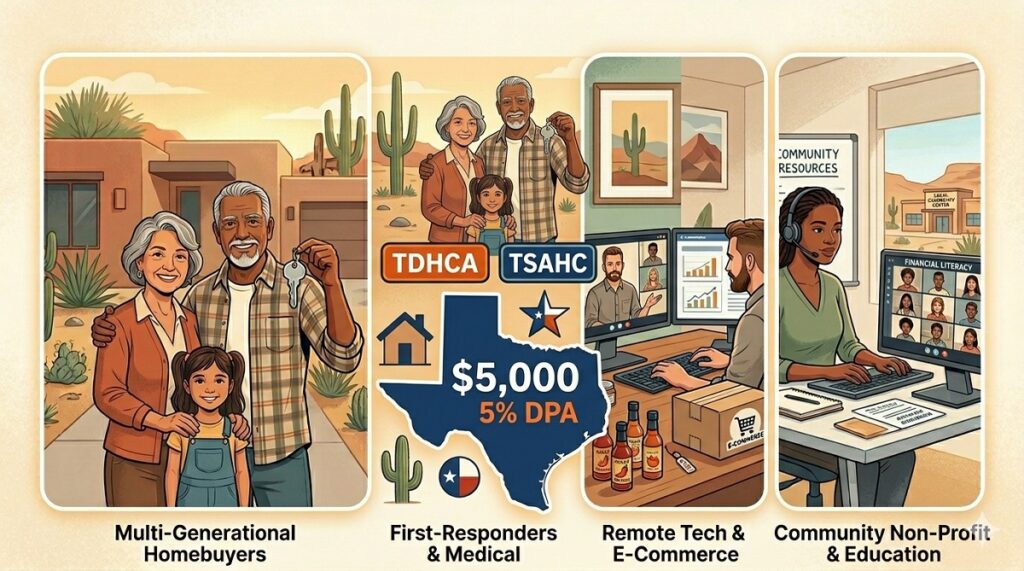
Texas has two of the most generous statewide buyer assistance agencies in the country. Most buyers who qualify never hear about either of them from their lender. Here is what you need to know.
TDHCA My First Texas Home
The Texas Department of Housing and Community Affairs (TDHCA) runs the My First Texas Home program, which most TDHCA-participating lenders should be guiding first-time buyers toward. My First Texas Home pairs a competitive 30-year fixed-rate mortgage with down payment and closing cost assistance of up to 5% of the loan amount. On a $325,000 home purchase, 5% assistance equals $16,250 in help with your upfront costs.
The program also offers a Texas Mortgage Credit Certificate (MCC) that provides a federal tax credit equal to 40% of the annual mortgage interest paid, up to $2,000 per year, and unused credits can be carried forward up to three years. That tax credit reduces your actual federal income tax bill, not just your taxable income. On a $325,000 mortgage at 6.5% interest, the first-year interest paid is roughly $20,800, meaning the MCC could deliver a $2,000 tax credit in year one alone. FHA.com
Eligibility requires that you have not owned a home as your primary residence in the past three years. Veterans are exempt from this requirement in many cases. Applicants must complete a homebuyer education course before closing, and income and purchase price limits apply by county. Check the current limits on the Texas Department of Housing and Community Affairs website before applying.
TSAHC Homes for Texas Heroes
The Texas State Affordable Housing Corporation runs the Homes for Texas Heroes program, which provides home loans and down payment assistance specifically for teachers, first responders, corrections officers, and veterans across all 254 Texas counties. Texas State Affordable Housing Corporation
Down payment assistance under Homes for Texas Heroes is available as a grant covering up to 5% of the loan amount that does not need to be repaid at all, or as a 0% interest deferred second lien that is fully forgiven after three years. The grant option is the most valuable because there is no repayment obligation under any circumstance. On a $325,000 FHA loan, a 5% grant equals $16,250 in zero-obligation assistance.
A Dallas firefighter buying a $325,000 home using FHA financing through Homes for Texas Heroes could receive a $11,375 grant covering the entire 3.5% FHA down payment, with closing costs being the only remaining out-of-pocket expense. That is a path to homeownership with almost zero upfront cash for an eligible buyer.
Who qualifies: Public school teachers and teacher aides, police officers, firefighters and EMS personnel, corrections officers, county jailers, and veterans of any branch. The minimum credit score required is 620. You do not need to be a first-time buyer.
TSAHC Home Sweet Texas: For Everyone Else
TSAHC’s Home Sweet Texas Home Loan Program extends similar down payment assistance of up to 5% to Texas buyers who are first-time homebuyers or who have not owned a home in the past three years, with income eligibility requirements that vary by county. Unlike Homes for Texas Heroes, this program is not limited to specific professions. If you do not qualify for Heroes, this is your fallback with the same grant structure.
City-Level Programs Worth Knowing
Texas cities add their own layer of assistance on top of state programs. Tarrant County offers up to $50,000 in down payment assistance, Fort Worth offers up to $25,000, and Arlington offers up to $20,000 for qualifying first-time buyers. These local programs stack on top of TSAHC or TDHCA assistance, potentially giving a DFW first-time buyer access to $60,000 or more in combined help.
In Houston, the NeighborhoodLIFT program offers up to $15,000 to eligible buyers who complete a homebuyer education course, with specific income limits that vary by household size. Check current availability directly with participating lenders since these local programs have limited funding and sometimes pause mid-year.
If you are planning to use FHA financing with any of these programs, our FHA loans guide covers exactly which lenders approve these combination applications most reliably.
Mistakes Texas Buyers Make When Choosing a Lender

After watching buyers go through this process across multiple Texas markets, the same four mistakes come up again and again. Every one of them costs money.
Mistake 1: Stopping at One Quote
This is the single most expensive thing a Texas buyer does wrong. The conforming loan limit in all Texas counties for 2026 is $832,750, but the rate you get on a $350,000 loan can vary by 0.25% to 0.50% on the exact same day between lenders for the exact same buyer. On a 30-year $350,000 loan, a 0.375% rate difference equals roughly $83 per month and more than $29,000 over the life of the loan. The CFPB’s own research consistently recommends getting at least three to five quotes before choosing a lender. That comparison takes one afternoon and costs nothing. Bankrate
Mistake 2: Using the Builder’s Lender Without Comparing
Builder-affiliated lenders like DHI Mortgage offer real rate buydowns that independent lenders cannot match on new construction. But the buydown only lasts for the introductory period, usually one or two years. Once it ends, your rate is fully market-rate. And some buyers report that the “incentives” tied to using the builder’s lender include closing cost credits that partially offset the rate discount you could have gotten elsewhere. Always get an outside quote before committing to a builder’s financing. Run both scenarios through our free refinance calculator to model the true long-term cost of each option.
Mistake 3: Not Checking DTI Before Applying
Texas first-time buyer programs through TDHCA and TSAHC have maximum DTI (debt-to-income ratio, which is your total monthly debt payments divided by your gross monthly income) limits that trip up buyers who have not calculated this ahead of time. TSAHC’s programs allow FHA manual underwrites up to 43% DTI with no additional fee when the credit score is at least 640. If you have a car payment, student loans, and credit cards, your DTI can easily push above 43% on a modest Texas salary. Use our free DTI calculator before your first lender meeting to see exactly where you stand and whether paying off one debt would open up better program eligibility. Texas State Affordable Housing Corporation
Mistake 4: Underestimating Texas-Specific Closing Costs
Texas has some unique closing cost considerations that out-of-state buyers and even some Texas buyers miss. Property taxes in Texas are among the highest in the country, averaging 1.6% to 2.5% of assessed value depending on county. On a $350,000 home, annual property taxes can run $5,600 to $8,750. Lenders will factor this into your escrow payment at closing. New construction homes in Houston’s outer suburbs often sit within Municipal Utility Districts (MUD) that add a separate tax of $0.50 to $1.50 per $100 of assessed value on top of county taxes. This alone can add $175 to $525 per month to your total housing cost on a $350,000 home. Standard closing costs in Texas typically run 2% to 5% of the purchase price, meaning $7,000 to $17,500 on a $350,000 purchase.
Who Should NOT Use Texas State Assistance Programs
Being honest about this saves time and frustration.
If your household income exceeds the TDHCA income limits for your county, you will not qualify for My First Texas Home. Limits vary significantly by county and household size, so check the TDHCA website for the current figures before assuming you qualify. In many Texas metro counties, the income cap for a family of four sits in the $82,000 to $94,000 range.
If you are not a first-time buyer and do not belong to one of the Homes for Texas Heroes qualifying professions, Homes for Texas Heroes is not available to you. TSAHC’s Home Sweet Texas program would be your alternative.
High-credit buyers with 740-plus scores who can put 20% down often benefit more from a clean conventional loan without the program overlays. A strong credit profile can produce rates 0.25% to 0.375% below what a program borrower would receive, and over 30 years that gap compounds significantly. Run the math before assuming state assistance is automatically the best move.
How to Choose the Right Texas Lender for Your Situation
Start with your actual profile, not with whoever advertises most aggressively.
First-time buyer in Houston, San Antonio, or DFW with a 620 to 660 credit score and limited savings: Contact two to three TDHCA and TSAHC participating lenders specifically. Ask about combining Homes for Texas Heroes or My First Texas Home with local city-level grants. Compare the total out-of-pocket cost, not just the interest rate.
Active-duty or veteran near Fort Cavazos, Joint Base San Antonio, or any Texas installation: Start with Veterans United for VA expertise, then ask a Fairway or PrimeLending officer to compare the VA loan against a TSAHC Heroes program loan to see which produces a lower total payment.
Self-employed buyer in Austin, Houston, or Dallas: CrossCountry Mortgage and New American Funding are your best starting points. Bring 24 months of business bank statements to your first conversation before you pull tax returns, and let the loan officer run the numbers both ways.
New construction buyer in DFW, Houston suburbs, or San Antonio’s northwest growth corridors: Get DHI’s or the builder’s offer in writing, then compare it against at least one independent lender quote. Use our mortgage rate comparison tool to establish what a fair market rate actually is before you sit across from any builder’s financing team.
Refinancer who locked above 7% in 2023 or 2024: Check Rocket first for streamline options, but also ask your current servicer for a retention offer. Rocket dominated Texas refinancing volume and their FHA Streamline and VA IRRRL processes are genuinely faster than most lenders. Compare both, then run the break-even timeline on our refinance calculator before you commit. The Truth About Mortgage
Before walking into any lender meeting in Texas, use our mortgage rate comparison tool to see current rate ranges for each loan type. Knowing what a competitive offer looks like before you sit down changes the entire conversation in your favor.