Best Mortgage Lenders in San Diego California (2026): Top Picks & Reviews
Buying a home in San Diego, California, is an exciting prospect, offering a vibrant lifestyle, stunning coastlines, and a thriving economy. However, it’s also a highly competitive and expensive market, making your choice of mortgage lender incredibly important. Securing the right financing can mean the difference between realizing your San Diego homeownership dream and facing unexpected hurdles.
As a prospective homebuyer, you need a lender who understands the unique dynamics of the San Diego market, offers competitive rates, and provides excellent service. This guide will walk you through the specifics of finding the best mortgage lenders in San Diego for 2026, covering everything from understanding local loan limits and down payment assistance programs to identifying lenders suited for various borrower profiles.
Our goal at MortgageTune.com is to provide you with the unbiased information you need to make an informed decision. Remember, we are not licensed financial advisors or mortgage brokers; we are expert researchers and educators helping you understand the market.
San Diego Mortgage Market at a Glance (2026)
San Diego County is known for its desirable but high-cost housing market. Understanding the local context, particularly loan limits and typical home values, is crucial before you begin your search for a lender.
Understanding San Diego’s High-Cost Housing
San Diego consistently ranks among the most expensive housing markets in the United States. This is driven by factors like strong job growth, limited housing supply, and high demand from those seeking its appealing climate and lifestyle. For homebuyers, this means higher median home prices, which directly impact the size of the mortgage you’ll need and the loan programs available to you. As of late 2025/early 2026, the median home price in San Diego County frequently hovers between $900,000 and $1,000,000, although this can fluctuate.
Key Loan Limits for San Diego County (2026)
Loan limits are the maximum amounts you can borrow for certain types of mortgages before they fall into “jumbo” territory. In high-cost areas like San Diego, these limits are set higher than the national standard. For 2026, the conventional and FHA loan limits in San Diego County are expected to remain at or near their 2025 levels, which were significantly elevated.
- Conventional Loan Limits: For a single-unit property in San Diego County, the conforming loan limit (the maximum amount for a loan eligible to be purchased by Fannie Mae and Freddie Mac) for 2026 is anticipated to be around $1,149,825. This allows many buyers to secure a conventional loan even with San Diego’s high home prices.
- FHA Loan Limits: The Federal Housing Administration (FHA) also sets higher loan limits for high-cost areas. For a single-unit property in San Diego County in 2026, the FHA loan limit is expected to be approximately $1,149,825. This makes FHA loans a viable option for many San Diego buyers, especially first-time homebuyers or those with lower credit scores.
- VA Loan Limits: For eligible veterans with full entitlement, the Department of Veterans Affairs (VA) does not impose a maximum loan amount in most cases. However, the amount a lender will finance without a down payment is influenced by the county loan limits, as this is the maximum amount the VA guarantees. For 2026, lenders in San Diego will generally offer VA loans up to the conventional loan limit ($1,149,825) without a down payment for eligible borrowers, and larger amounts with an appropriate down payment.
- USDA Loan Limits: USDA loans (United States Department of Agriculture) are designed for rural properties and are generally not applicable to most of San Diego County, which is predominantly urban or suburban. Specific rural areas might qualify, but this is less common.
These limits are subject to annual adjustments by the Federal Housing Finance Agency (FHFA) for conventional loans and the Department of Housing and Urban Development (HUD) for FHA loans.

Top Mortgage Lenders in San Diego by Buyer Need
Choosing the “best” lender isn’t about finding a single top-ranked institution; it’s about finding the best fit for your specific financial situation and homebuying goals. San Diego’s diverse market means different lenders excel in different areas. Here’s a breakdown by common buyer needs, including examples of lender types and prominent institutions known to operate in the San Diego area.
Best for First-Time Homebuyers
First-time homebuyers often need extra guidance, competitive rates, and access to down payment assistance (DPA) programs. Lenders with strong customer service and experience with government-backed loans (FHA, VA) and DPA initiatives are ideal.
- Lender Types: Local credit unions, community banks, and larger national lenders with dedicated first-time buyer programs.
- Examples: Many San Diego-based credit unions (e.g., California Coast Credit Union, Mission Federal Credit Union) often have a strong community focus and familiarity with local DPA programs. National lenders like Guild Mortgage and Fairway Independent Mortgage Corporation also have strong reputations for working with first-time buyers and offering a range of loan products.
- Key Consideration: Look for lenders who are proficient in navigating state-level programs like CalHFA (California Housing Finance Agency) which offers various DPA options. A good lender will help you integrate these benefits seamlessly. You can explore your estimated monthly payments with different down payment scenarios using our [Mortgage Calculator](/mortgage-calculator-2025/).
Best for VA Loans (Veterans and Service Members)
Given San Diego’s significant military presence, many lenders specialize in VA loans, offering expertise in the unique benefits and processes involved.
- Lender Types: Lenders with dedicated VA loan departments and loan officers who are highly experienced with military benefits.
- Examples: Navy Federal Credit Union and USAA are popular choices for military members due to their member-focused services. Other national lenders like Veterans United Home Loans, PenFed Credit Union, and Caliber Home Loans are also well-regarded for their VA loan expertise and often have a strong presence in military communities like San Diego.
- Key Consideration: A lender that understands the specifics of VA funding fees, entitlement, and the appraisal process is essential.
Best for Jumbo Loans
With San Diego’s high home prices, many properties exceed conventional loan limits, requiring jumbo financing. These loans typically have stricter qualification criteria.
- Lender Types: Large national banks, investment banks, and some private mortgage lenders often specialize in jumbo loans due to the higher capital requirements.
- Examples: Institutions like Chase, Wells Fargo, Bank of America, U.S. Bank, and Flagstar Bank are frequent providers of jumbo mortgages in San Diego.
- Key Consideration: Expect requirements such as a higher credit score (typically 700+), larger down payments (10-20% or more), and substantial cash reserves (6-12 months of mortgage payments). Understanding these criteria is critical when using our loan eligibility checker.
Best for Low Down Payment Options
Not everyone has a substantial down payment saved, and various programs can help.
- Lender Types: Lenders strong in FHA loans, VA loans (0% down), and conventional loans with low down payment options (e.g., Fannie Mae’s HomeReady or Freddie Mac’s Home Possible, requiring 3% down).
- Examples: Many national and regional banks, as well as mortgage bankers like Rocket Mortgage (for online convenience) and LoanDepot, offer a wide array of low down payment options.
- Key Consideration: While FHA loans require only 3.5% down, they come with mortgage insurance premiums (MIP) for the life of the loan. Conventional 3% down programs might have private mortgage insurance (PMI) which can be canceled later. Weighing these costs is important.
Best for Self-Employed Borrowers
Self-employed individuals often face unique challenges in proving income. Lenders offering alternative documentation programs are key.
- Lender Types: Portfolio lenders (those who keep loans on their books rather than selling them), some private mortgage lenders, and lenders specializing in non-qualified mortgage (non-QM) products.
- Examples: While specific national lenders may have non-QM divisions, often smaller brokers or specialized private lenders are better equipped to handle bank statement loans or other alternative income verification methods.
- Key Consideration: Be prepared to provide extensive documentation, including 12-24 months of bank statements, profit and loss statements, and business tax returns. Your debt-to-income ratio (DTI) will be scrutinized, so use our DTI calculator to prepare.
Best for Fast Closings
In San Diego’s competitive market, a quick closing can make your offer more attractive to sellers.
- Lender Types: Online lenders, some direct mortgage lenders, and local mortgage brokers with efficient in-house processing.
- Examples: Rocket Mortgage (Quicken Loans), LoanDepot, and some tech-forward regional banks often emphasize speed. Local mortgage brokers who work closely with a network of lenders can also often expedite the process.
- Key Consideration: While speed is important, ensure it doesn’t come at the cost of thoroughness or competitive rates. Communicate your need for a fast closing upfront.
Best for Refinancing Options
Whether you’re looking to lower your interest rate, change your loan term, or tap into your home equity, refinancing can be a smart move.
- Lender Types: Most major banks, credit unions, and online lenders offer robust refinancing programs.
- Examples: Wells Fargo, Chase, Bank of America, and online platforms like Better Mortgage or Rocket Mortgage are all strong contenders for refinancing. Consider your current lender first, as they might offer streamlined options.
- Key Consideration: Use our refinance calculator to determine if refinancing makes financial sense for you based on current rates and your goals. Look for lenders with low closing costs for refinances.

Navigating Loan Options in San Diego
Understanding the different loan types available is fundamental to choosing the right financing for your San Diego home.
Conventional Loans in a High-Cost Area
Conventional loans are the most common type of mortgage and are not insured or guaranteed by the government.
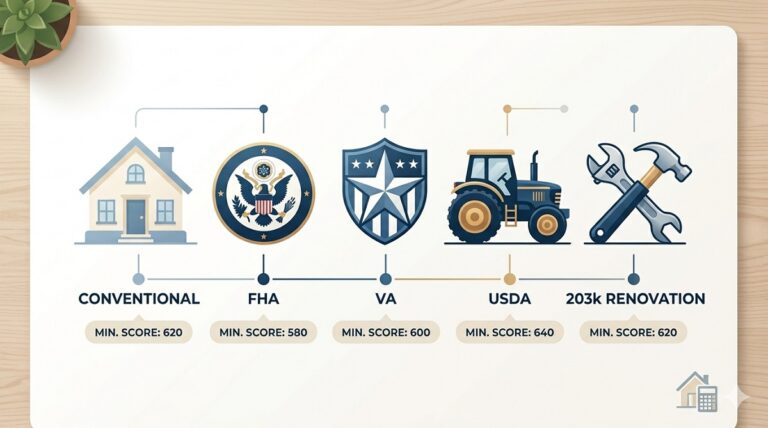
- How They Work: Backed by private lenders and conforming to Fannie Mae and Freddie Mac guidelines, conventional loans typically require a credit score of 620 or higher, with 680+ being ideal for the best rates. Down payments can be as low as 3% for qualified borrowers, though 20% or more avoids private mortgage insurance (PMI).
- San Diego Relevance: With conforming loan limits in San Diego reaching over $1.1 million, conventional loans are a primary option for many buyers, even for higher-priced homes. They offer flexibility and generally lower overall costs than FHA loans if you have a strong credit profile and a good down payment.
FHA Loans: An Accessible Path to Homeownership
FHA loans are insured by the Federal Housing Administration, making them a popular choice for first-time buyers and those with less-than-perfect credit.
- How They Work: They require a minimum credit score of 580 with a 3.5% down payment, or 500 with a 10% down payment. FHA loans come with two types of mortgage insurance: an Upfront Mortgage Insurance Premium (UFMIP) paid at closing (or financed into the loan) and an annual Mortgage Insurance Premium (MIP) paid monthly.
- San Diego Relevance: The high FHA loan limits in San Diego County (expected at $1,149,825 for 2026) make them a powerful tool for accessing homeownership in an expensive market with a relatively low down payment. They are particularly useful for those whose credit score might not qualify for the best conventional rates.
VA Loans: Benefits for Service Members and Veterans
VA loans are a phenomenal benefit for eligible service members, veterans, and surviving spouses, guaranteed by the Department of Veterans Affairs.
- How They Work: The most significant advantage is 0% down payment, no private mortgage insurance (PMI), and competitive interest rates. While there’s no set loan limit from the VA for eligible borrowers with full entitlement, lenders typically adhere to conventional loan limits for no-down-payment loans. A VA funding fee is usually required, but it can be waived for veterans with service-connected disabilities.
- San Diego Relevance: Given San Diego’s large military population, VA loans are widely used and understood by local lenders. They offer an unparalleled opportunity for eligible buyers to purchase a home with no down payment, which is a major advantage in a high-cost market.
USDA Loans: Limited Applicability but Worth Checking
USDA loans are designed to promote homeownership in rural and suburban areas, backed by the U.S. Department of Agriculture.
- How They Work: These loans offer 0% down payment and competitive interest rates, along with a rural development fee. Income limits apply, and the property must be located in an eligible rural area as defined by the USDA.
- San Diego Relevance: Most of San Diego County is not classified as rural by the USDA. However, a few outlying areas might qualify. It’s always worth checking the USDA eligibility map if you are considering properties further afield from the urban core, though this is rare for typical San Diego home searches.
Jumbo Loans: Financing Beyond Conforming Limits
Jumbo loans are non-conforming mortgages that exceed the conventional loan limits set by Fannie Mae and Freddie Mac.
- How They Work: For San Diego County in 2026, any loan above approximately $1,149,825 would be considered a jumbo loan. These loans typically have stricter underwriting requirements, including higher credit score minimums (often 700-740+), larger down payments (10-20% is common), and more substantial cash reserves (6-12 months of mortgage payments).
- San Diego Relevance: With San Diego’s median home prices frequently approaching or exceeding $1 million, many homebuyers will find themselves needing a jumbo loan to purchase their desired property. It’s crucial to work with a lender experienced in this niche.
San Diego Down Payment Assistance (DPA) Programs
Navigating the cost of a down payment and closing costs in San Diego can be challenging. Fortunately, several down payment assistance (DPA) programs are available at both state and local levels to help eligible buyers.
State-Level Programs (CalHFA)
The California Housing Finance Agency (CalHFA) is the primary statewide resource for DPA. CalHFA offers various programs that can be layered with FHA, VA, or conventional loans.
- MyHome Assistance Program: Provides a deferred-payment junior loan that can be used for down payment or closing costs.
- Extra Credit Teacher Program (ECTP): Offers additional assistance to eligible teachers, administrators, and other school staff.
- CalHFA Dream for All Shared Appreciation Loan: A newer program designed to help first-time homebuyers with up to 20% of the purchase price as a shared appreciation loan.
- How They Work: CalHFA programs often come in the form of subordinate loans (second mortgages) that are deferred until you sell the home, refinance, or pay off the first mortgage. Income limits and other eligibility criteria apply.
- Key Consideration: Not all lenders are approved to originate CalHFA loans. When speaking with lenders in San Diego, explicitly ask if they participate in CalHFA programs if you plan to utilize DPA.
Local San Diego Programs
While CalHFA is the most prominent, some local jurisdictions or non-profits within San Diego County may offer their own specific DPA programs. These are often smaller in scale and have very specific geographic or income requirements.
- Examples: Programs might be offered by the City of San Diego or specific community development corporations. These can include grants or deferred loans.
- How to Find Them: The best way to identify local DPA programs is to consult with a local mortgage lender or broker familiar with the San Diego market, or check the websites of the City of San Diego’s housing department or San Diego County’s housing authority.
- Key Consideration: Local programs can be highly competitive and may have limited funding. It’s important to research eligibility early and have all necessary documentation prepared.
How to Choose the Right San Diego Mortgage Lender
Selecting a mortgage lender is one of the most significant decisions in your homebuying process. Don’t rush it. Here’s how to approach your choice strategically.
Compare Rates and Fees
This is often the first step for many buyers, and for good reason. Even a small difference in interest rates can save you tens of thousands of dollars over the life of a 30-year mortgage.
- Specifics: Always request a Loan Estimate (LE) from multiple lenders. This standardized document clearly outlines the interest rate, annual percentage rate (APR), closing costs, and other fees. Pay close attention to origination fees, appraisal costs, and third-party fees.
- Action: Use our rate comparison tool to get an idea of current market rates, then gather personalized quotes from at least three different lenders. Compare the APR, not just the interest rate, as APR reflects the true annual cost of the loan including most fees.
Evaluate Lender Communication and Service
A smooth mortgage process relies heavily on clear, timely communication from your lender.
- Specifics: During your initial interactions, assess how quickly they respond to your inquiries, how thoroughly they explain complex terms, and how accessible their loan officers are. Do they seem genuinely interested in understanding your needs, or are they pushing a specific product?
- Action: Read online reviews (Google, Zillow, Yelp, BBB), and ask for referrals from trusted real estate agents or friends who have recently purchased in San Diego. A helpful and communicative lender can reduce stress during what can be a complex transaction.
Consider Lender Specialties and Loan Products
Some lenders excel in specific areas. Aligning your needs with a lender’s strengths can be beneficial.
- Specifics: If you’re a veteran, look for lenders with strong VA loan departments. If you’re self-employed, seek out those experienced with alternative income verification. First-time buyers might prefer lenders known for their educational resources and DPA program expertise.
- Action: During your initial conversations, clearly state your situation and ask about their experience with your specific needs.
Read Reviews and Get Referrals
What other homebuyers have experienced can offer valuable insights.
- Specifics: Look for patterns in reviews – do many mention slow processing, poor communication, or unexpected fees? Conversely, do many praise efficiency, transparency, and helpfulness?
- Action: Don’t just look at the star rating; read the specific comments. Speak to your real estate agent, who often has extensive experience working with various local lenders in San Diego. They can offer insights into which lenders consistently deliver.
Common Mortgage Mistakes to Avoid in San Diego
The San Diego housing market is competitive, and avoiding common pitfalls can save you time, money, and stress.
Not Getting Pre-Approved Early
A pre-approval is a crucial step that tells sellers you are a serious and qualified buyer.
- Specifics: A pre-approval letter from a lender states the maximum loan amount you qualify for, based on a preliminary review of your finances. In San Diego, where bidding wars can be common, offers accompanied by strong pre-approval letters are often prioritized.
- Impact: Without one, your offer might not even be considered. Moreover, it helps you budget realistically using our Affordability Calculator 2025 – Mortgagetune Get pre-approved before you start seriously touring homes.
Ignoring Your Credit Score
Your credit score is a major factor in determining your interest rate and loan eligibility.
- Specifics: A higher credit score (generally above 740) can qualify you for the lowest interest rates, saving you significantly over the loan term. Even a 20-point difference can impact your monthly payment by tens of dollars.
- Impact: Neglecting your credit can lead to higher interest rates, more stringent loan terms, or even denial. Check your credit report for errors and work to improve your score well before applying for a mortgage. Avoid opening new credit lines or making large purchases before closing.
Failing to Budget for Closing Costs and Reserves
The purchase price is only one part of the equation. Closing costs and having adequate reserves are essential.
- Specifics: Closing costs typically range from 2% to 5% of the loan amount and include appraisal fees, title insurance, escrow fees, and lender fees. For a $900,000 home, this could mean $18,000 to $45,000. Additionally, lenders often require you to have 2-6 months of mortgage payments in reserve after closing.
- Impact: Underestimating these costs can leave you short on funds at closing or unable to meet lender requirements, delaying or even derailing your home purchase. Always have a clear understanding of all associated costs.
Only Comparing One Lender
Settling for the first lender you speak with can be a costly mistake.
- Specifics: Mortgage rates and fees vary significantly between lenders, sometimes by as much as half a percentage point or more on the interest rate alone. For example, on a $700,000 loan, a 0.25% difference in rate could mean over $1,000 per year in interest.
- Impact: Without comparing multiple offers, you risk overpaying for your mortgage. It’s advisable to get quotes from at least three different lenders or use a mortgage broker who can access multiple options for you. Use our mortgage rate comparison tool 2025 to simplify this process.
Who Should NOT Pursue a Mortgage in San Diego Right Now?
While homeownership is a goal for many, it’s not always the right time for everyone, especially in a market as expensive as San Diego. It’s important to be honest about your current financial situation.
Individuals with Unstable Employment or Income
Mortgage lenders require consistent, verifiable income to ensure you can make your monthly payments.
- Specifics: If you’ve recently changed jobs multiple times, are in a probationary period, or have income sources that are highly variable or uncertain, lenders will view this as a significant risk. Most prefer at least two years of stable employment history.
- Reason to Avoid: An unstable income makes it difficult to qualify for a loan and can put you at risk of default if your income declines. Stabilizing your employment for at least 12-24 months is a prudent step before applying.
Those Without a Sufficient Down Payment or Emergency Savings
Even with low down payment options, having a financial cushion is vital.
- Specifics: While programs like FHA allow 3.5% down, and VA loans allow 0% down, you still need funds for closing costs (2-5% of the loan amount). More importantly, maintaining an emergency fund of 3-6 months of living expenses (beyond your down payment and closing costs) is critical for financial resilience as a homeowner.
- Reason to Avoid: Without adequate savings, you could find yourself in a financially precarious position if unexpected home repairs arise (which they inevitably do) or if you face a temporary loss of income. Save consistently until you have both your down payment/closing costs and a solid emergency fund.
Borrowers with High Debt-to-Income Ratios
Your DTI (debt-to-income) ratio is a key metric lenders use to assess your ability to manage monthly payments.
- Specifics: Lenders generally prefer a DTI ratio below 43-45%, meaning your total monthly debt payments (including the proposed mortgage) should not exceed 43-45% of your gross monthly income. Some programs allow up to 50%, but this often requires strong compensating factors like excellent credit or significant reserves.
- Reason to Avoid: A high DTI indicates that a large portion of your income is already committed to debt, leaving little room for a mortgage payment. This increases the risk of financial strain. Focus on paying down high-interest debts (credit cards, personal loans) to lower your DTI before pursuing a mortgage. Our [DTI Calculator](/dti-calculator-2025/) can help you assess your current situation.
Next Steps for Your San Diego Mortgage Journey
Finding the best mortgage lender in San Diego for your needs requires thorough research and careful consideration. Start by understanding your financial health, evaluating your credit score, and determining how much you can realistically afford.
1. Assess Your Finances: Use our Affordability Calculator 2025 to get a clear picture of what you can afford.
2. Get Pre-Approved: This is your first concrete step towards making an offer on a San Diego home.
3. Compare Lenders: Speak with multiple lenders, review their Loan Estimates, and compare not just rates, but also fees, service, and expertise in your specific loan type.
5. Stay Informed: Continue reading expert guides and articles on our [Blogs Hub](/blogs/) to stay current on market trends and mortgage advice.
By taking these diligent steps, you’ll be well-prepared to secure the best possible mortgage for your San Diego home in 2026 and beyond.
Disclaimer: This article is for informational purposes only and does not constitute financial advice. MortgageTune.com is not a licensed financial advisor or mortgage broker. Always consult with a qualified, licensed mortgage professional to discuss your specific financial situation and needs. Loan limits, interest rates, and program requirements are subject to change annually and based on market conditions.
This article is for informational purposes only and does not constitute financial or legal advice. Mortgage rates, loan limits, and program requirements change frequently. Always consult a licensed mortgage professional and verify current rates directly with lenders before making any financial decisions.