30-Year Fixed Rate Mortgages: The Definitive Guide
Understanding the 30-Year Fixed Mortgage
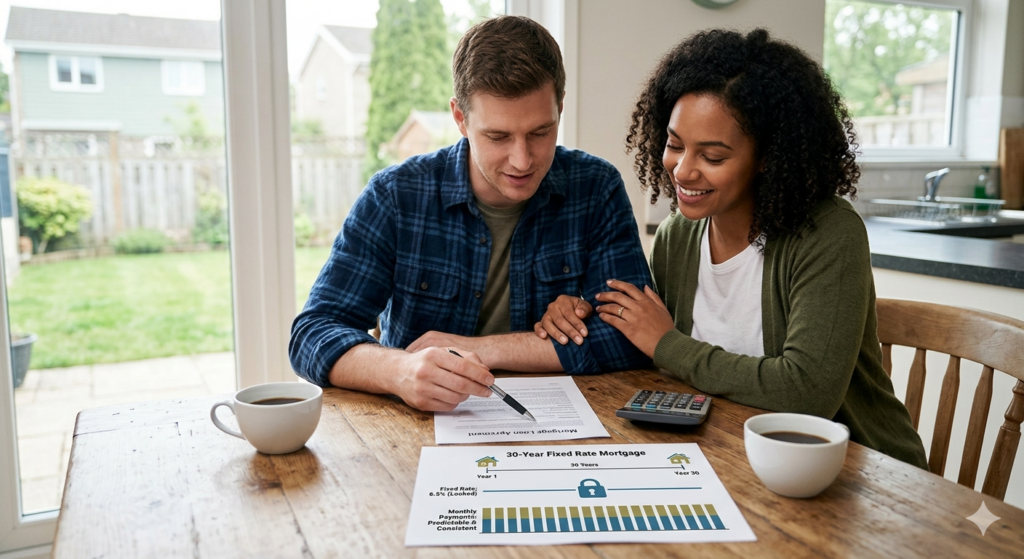
The 30-year fixed-rate mortgage is America’s most popular home financing product. It allows borrowers to purchase a home with a loan that spans exactly thirty years, or three hundred sixty months.
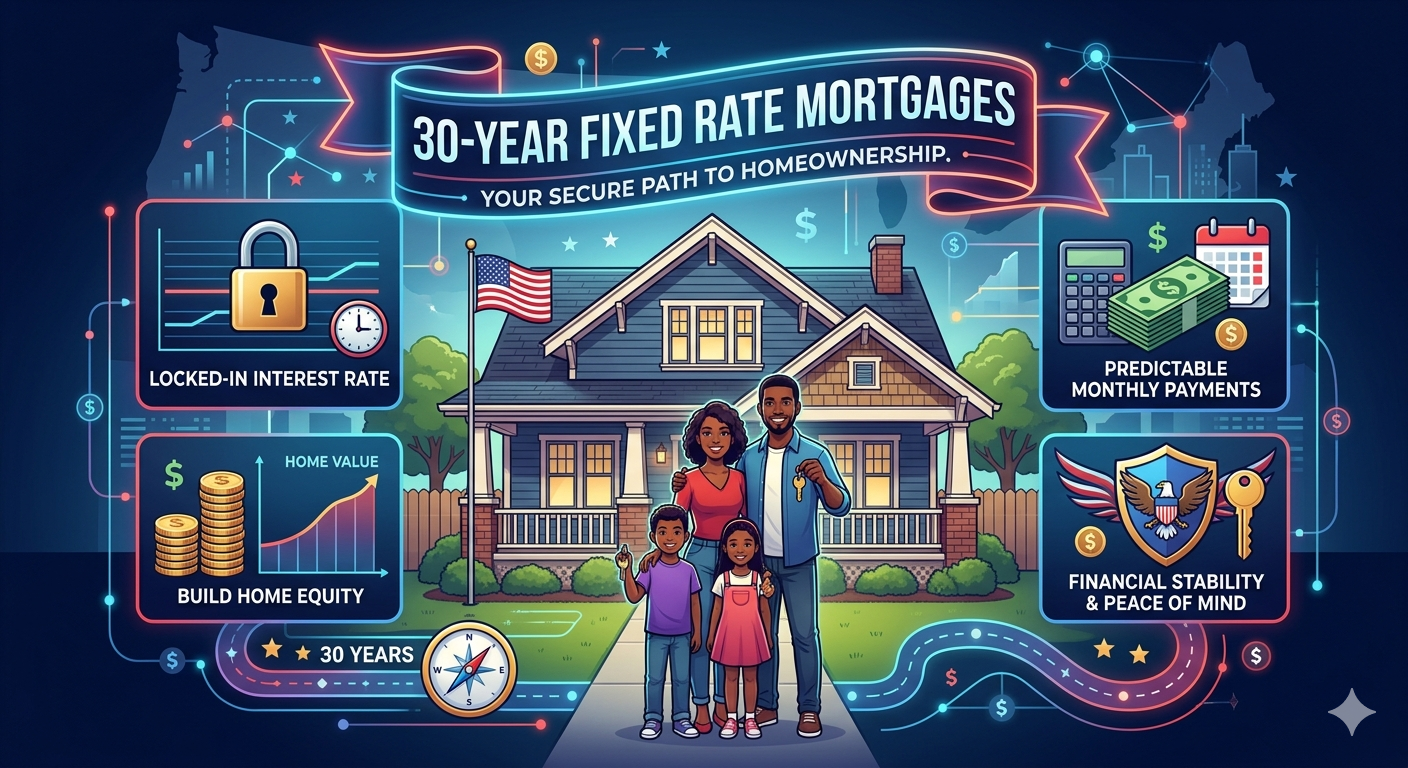
Here’s what makes it special: your interest rate stays the same for the entire thirty years. Whether interest rates go up or down, your rate remains locked in. This predictability is one of the biggest reasons homebuyers choose this mortgage type.
In April 2026, the 30-year fixed-rate mortgage averaged 6.7%, according to Freddie Mac data. This represents a slight decrease from the previous week when rates averaged 6.46%. These rates are based on actual loan applications submitted to Freddie Mac by lenders across the United States.
The monthly payment structure is carefully calculated. Early in the loan, most of your payment goes toward interest. As years pass, more of your payment goes toward reducing the principal balance. By year thirty, you’re primarily paying off the remaining principal.
This amortisation structure has remained consistent since American mortgage lending became standardised. It ensures your payment stays the same while gradually building your home equity over time.
Historical Context: How We Got Here
To understand today’s rates, we need to look at where rates have been. The 30-year fixed-rate mortgage hit a record low of 2.65% on January 7, 2021. This was during the COVID-19 pandemic when the Federal Reserve slashed interest rates to nearly zero.
That emergency action, combined with massive government stimulus, created extraordinary conditions. Mortgage rates tumbled as investors sought safer investments like mortgage-backed securities. Many homeowners rushed to refinance existing mortgages into these record-low rates.
On the opposite end of the spectrum, December 1994 saw rates hit 8.89%. This was during a period of high inflation when the Federal Reserve was aggressively raising rates to combat rising prices. Compared to that, today’s 6.37% seems reasonable.
The journey from 2021’s lows to today’s 6.37% tells an important story. When pandemic restrictions ended, inflation accelerated rapidly. Supply chain problems combined with huge government spending created too much money chasing too few goods.
The Federal Reserve responded by raising interest rates sharply starting in 2022. They went from near-zero to over 5% in about a year. This was one of the fastest rate-hiking cycles in Federal Reserve history.
Mortgage rates rose along with Fed rates because they track the ten-year Treasury yield. When Treasury yields go up, mortgage rates follow. The current 6.37% reflects an economy still fighting inflation while trying to support employment.
A year ago this month, the 30-year fixed mortgage averaged 6.62%. So we’ve actually improved slightly, though rates remain elevated compared to the 2020-2021 period.
The Advantages: Why Most Homebuyers Choose This
Payment predictability is the biggest advantage. Your mortgage payment never changes for thirty years. This enables solid financial planning and budgeting.
Think about it: you can commit confidently to your housing payment whether you’re thirty years old or approaching retirement. Unexpected income changes won’t jeopardise your home.
For retirees especially, this is invaluable. A fixed payment on a fixed retirement income provides peace of mind. You’re not worried that rising interest rates will force a payment increase.
Another huge advantage is affordability through lower monthly payments. Compared to a 15-year mortgage, your monthly payment is significantly lower with a 30-year term.
For a $300,000 loan at 6.37%, the monthly payment is approximately $1,844. The same loan over fifteen years would cost about $2,384 monthly. That’s a $540 difference each month, or $6,480 annually.
This payment difference often determines whether borrowers qualify for mortgages. Most lenders limit housing payments to 43% of gross household income. A lower payment means you can afford a more expensive home with the same income.
This product also enables homeownership for borrowers with moderate incomes who couldn’t qualify for shorter-term mortgages. Without the 30-year option, many families wouldn’t be able to buy homes.
There’s also flexibility for accelerated payoff. If you have extra money for one month, you can make an additional principal payment without penalty. This accelerates equity building if you’re able to do so.
You maintain the security of a fixed payment while retaining the option to pay faster if circumstances improve. This flexibility is perfect for many households.
The Disadvantages: What You Need to Know
The biggest disadvantage is total interest paid. Over thirty years, you’ll pay substantially more interest than with a 15-year mortgage.
For that $300,000 loan at 6.37%, total interest paid would be approximately $362,690. With a 15-year term, total interest drops to roughly $138,680. That’s a difference of $224,010.
This represents a significant opportunity cost. That extra $224,010 could have been invested in retirement accounts, investment portfolios, or other wealth-building vehicles.
For borrowers with high incomes and long investment time horizons, this disadvantage becomes meaningful. The maths might favour a shorter mortgage term.
Another issue is slow initial equity accumulation. In the early years of your mortgage, most of each payment goes toward interest, not principal.
In the first payment of a 30-year, $300,000 loan at 6.37%, roughly $1,592 goes to interest and only $252 to principal. You’re building equity slowly at first.
This creates challenges if you need to refinance or access home equity early. With minimal equity accumulated, your options become limited. You might face difficulty getting approved for a home equity loan.
The 30-year mortgage also makes an implicit bet about inflation. Fixed mortgages benefit when inflation rises because your payment’s real value decreases over time.
Comparing Your Options
The 15-year fixed-rate mortgage is the main alternative. It requires higher monthly payments but builds equity much faster and costs significantly less in total interest.
In April 2026, the 15-year mortgage averaged 5.74%, about 63 basis points lower than the 30-year rate. This lower rate reflects less duration risk for the lender.
If you can afford that higher $2,384 monthly payment on a $300,000 loan, the 15-year option saves you $224,010 in interest. For high-income borrowers, this might be the better choice.
You’d also own your home free and clear fifteen years earlier. Many borrowers approaching retirement prefer this approach.
Adjustable Rate Mortgages (ARMs) offer a third option. They provide lower initial rates in exchange for future uncertainty.
A typical ARM might offer a low rate for three, five, seven, or ten years. After that period, the rate adjusts annually based on market rates plus the lender’s margin.
ARMs appeal to borrowers planning to sell or refinance within the fixed-rate period. You benefit from lower initial payments without worrying about rate adjustments.
However, ARMs carry significant risk. If you underestimate how long you’ll stay in the home, rising rates could increase payments dramatically. ARMs played a major role in the 2008 housing crisis when many homeowners faced unaffordable payments after rates reset.
When Should You Choose the 30-Year Mortgage?
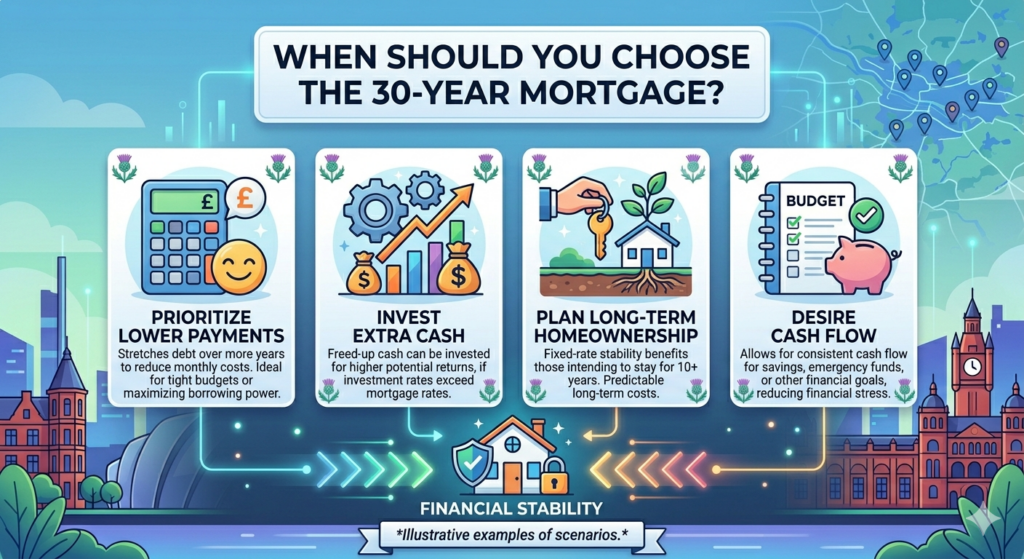
The 30-year mortgage is ideal if you have a moderate income where the lower payment is necessary to qualify.
If your household earns $75,000 annually, a 15-year mortgage might make you ineligible due to debt-to-income limits. The 30-year payment might be the only option enabling homeownership.
This mortgage also suits borrowers with other debt obligations. If you’re managing student loans, car payments, or credit card debt, the lower housing payment helps your overall debt-to-income ratio.
First-time homebuyers should seriously consider 30-year mortgages regardless of income. Homeownership brings unexpected costs: property taxes, insurance, maintenance, and repairs. The lower payment provides breathing room as you adjust.
The payment stability matters psychologically. Knowing your housing cost won’t change lets you plan confidently for other financial goals.
If you plan to stay in your home long-term without specific relocation plans, the 30-year mortgage makes sense. The psychological security often outweighs the mathematical disadvantage of higher total interest.
Final Thoughts: Making Your Decision
Stop trying to perfectly time mortgage markets. You’ll likely get it wrong, and the cost of being wrong exceeds the benefit of being right.
Instead, focus on your personal circumstances. Evaluate your income stability, other debt obligations, time horizon in the home, and financial discipline.
If you have a closing timeline coming up, lock your rate without excessive delay. Current rates provide reasonable entry points.
The 30-year fixed mortgage will likely remain the most popular option because it solves real problems for typical American households. Payment certainty, affordability, and flexibility make sense for most borrowers.
Whether you choose 30-year or 15-year mortgages, make the decision based on your situation, not on rate forecasts or market timing attempts. Homeownership is a long-term commitment.
Your goal should be getting approved for a home you want at a rate you can manage, not achieving some theoretical optimum. Trust your analysis of your personal finances and move forward accordingly.